Colombia's president draws outrage by posing with bodies of alleged 'terrorists'
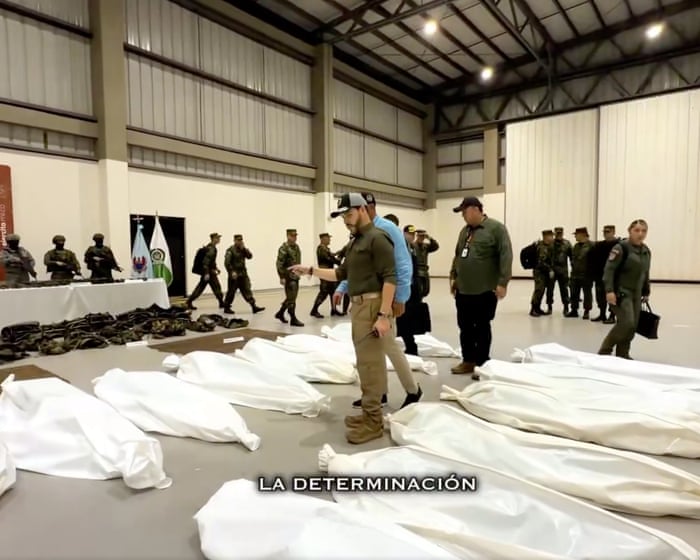
Colombian president Abelardo De La Espriella posted a social‑media video showing himself walking among rows of white body bags that he said held the corpses of 23 ‘neutralised’ guerrillas after an operation in the Amazon. De La Espriella, who assumed office last month pledging an “all‑out war” on illegal armed groups, accompanied the footage with messages denouncing killers and extolling his resolve. Human rights activists and political opponents condemned the clip as a grotesque spectacle, while the president defended his conduct as part of his duties. Observers link the episode to a broader wave of performative, hardline politics across the Americas that seeks public approval through dramatic displays of force.
What happened
Colombian president Abelardo De La Espriella posted a social‑media video in which he walks among rows of white body bags that he said contained the corpses of 23 “neutralised” guerrillas after a military operation in the Colombian Amazon. The footage, shared on Thursday, is scored with a stirring, Hollywood‑style soundtrack and was presented by the president as evidence he is delivering on his security promises.
De La Espriella, who assumed office last month, framed the post with a message: “I promised to confront terrorism without hesitation and I’m keeping that promise,” adding: “I did not come to play nice with murderers, extortionists and child recruiters. I came to defeat them … Long live Christ the king!”. He celebrated the operation’s outcome in the accompanying text, calling his adversaries “a cancer” to be destroyed.
The article notes that the president’s claim that the bags held 23 bodies is presented as his assertion—phrases such as “that he says contained” indicate the piece does not provide independent verification of the fatalities.
Why this is happening
De La Espriella entered office with hardline rhetoric and a pledge of “all‑out war” against illegal armed groups; the video appears intended to substantiate that commitment by showing a tangible result of a military action. The post functions as a performative demonstration of force, aligning public imagery with political messaging.
The reporting places the episode within a broader trend of performative populism across the Americas, where leaders use dramatic visuals to cultivate voter support. Examples cited include El Salvador’s president Nayib Bukele, known for polished videos of his mega‑prison, and Donald Trump’s releases of footage showing alleged drug boats being struck in maritime operations.
The piece also references developments in Brazil, where some candidates ahead of October elections promise lethal measures against traffickers. It quotes candidate Renan Santos saying, “We’re going to stain the ground red with the blood of these lowlifes,” and notes Flávio Bolsonaro’s pledge that criminals “will be taken out of circulation, either standing up or lying down.” Such examples illustrate how visually striking, hardline acts have become a campaign tactic in the region.
How this will affect
According to the source, the video drew condemnation from human‑rights activists and political opponents. Iván Cepeda, the left‑wing candidate De La Espriella defeated in June’s election, posted on X that the president “strolls among the bags with the corpses. He nearly treads on them with contempt,” and criticised the contrast between De La Espriella’s self‑presentation as a Christian and his conduct.
Left‑wing lawmaker Daniel Monroy accused the president of “necropolitics,” calling the footage “one of the most bizarre things we’ve seen” and describing the stroll among the dead while invoking God as an attempt to justify an “unnecessary spectacle.” Former president Gustavo Petro tweeted: “This is called turning death into a trophy – something only soulless people can do … The soulless find it easy to kill for the sake of killing.” These responses demonstrate strong political backlash and human‑rights concerns.
De La Espriella replied to critics with: “Forgiving terrorists is God’s business. Sending them to meet him – if that’s where they’re headed – is the president’s job.” The source shows that the president defends both the substance and the theatricality of his actions; however, whether this will affect legal accountability, military practice or rights oversight is not detailed in the article.
What happens next
The article notes that this episode is an early, high‑profile act by a president who assumed power last month, but it does not report any ensuing investigations, independent verification of the deaths, or specific actions by oversight bodies. Consequently, the immediate institutional consequences remain unclear.
The piece suggests that similar performative displays of force are likely to remain part of political playbooks in the region, particularly where elections and tough‑on‑crime messaging are prominent. It cites recent campaign material from Brazil as evidence that political actors continue to deploy striking imagery and violent rhetoric to win support.
What is known from the source is that the video has prompted public condemnation from several political figures and human‑rights advocates, and that the president has publicly defended his conduct. What is not established in the reporting includes independent confirmation of the 23 deaths, any legal or investigatory follow‑up, and the longer‑term impact on Colombia’s human‑rights record or regional politics.
What we know
- Abelardo De La Espriella posted a video walking among rows of white body bags that he said held the corpses of 23 “neutralised” guerrillas after an operation in the Amazon.
- The president, who took office last month, had vowed an “all‑out war” on illegal armed groups and framed the video as proof of that promise.
- Human‑rights activists and political opponents condemned the footage as a grotesque spectacle; the video was set to a stirring Hollywood‑style score.
- Iván Cepeda, Daniel Monroy and Gustavo Petro publicly denounced the post; De La Espriella replied: “Forgiving terrorists is God’s business. Sending them to meet him… is the president’s job.”
- The episode is presented in the article as part of a wider trend of performative hardline politics in the Americas, with comparisons to Nayib Bukele and Donald Trump.
What is being verified
- The newsroom is checking the report that abelardo De La Espriella posted a video walking among rows of white body bags that he said held the corpses of 23 neutralised guerrillas after an operation in the Amazon.
- Reporting from The Guardian World is being compared; a second independent confirmation is not yet available.
View sources1
COMMUNITY
Discussion
Sign in to join the discussion.
No comments yet. Start the discussion.